Showing posts with label Readings. Show all posts

Tuesday, September 23, 2014

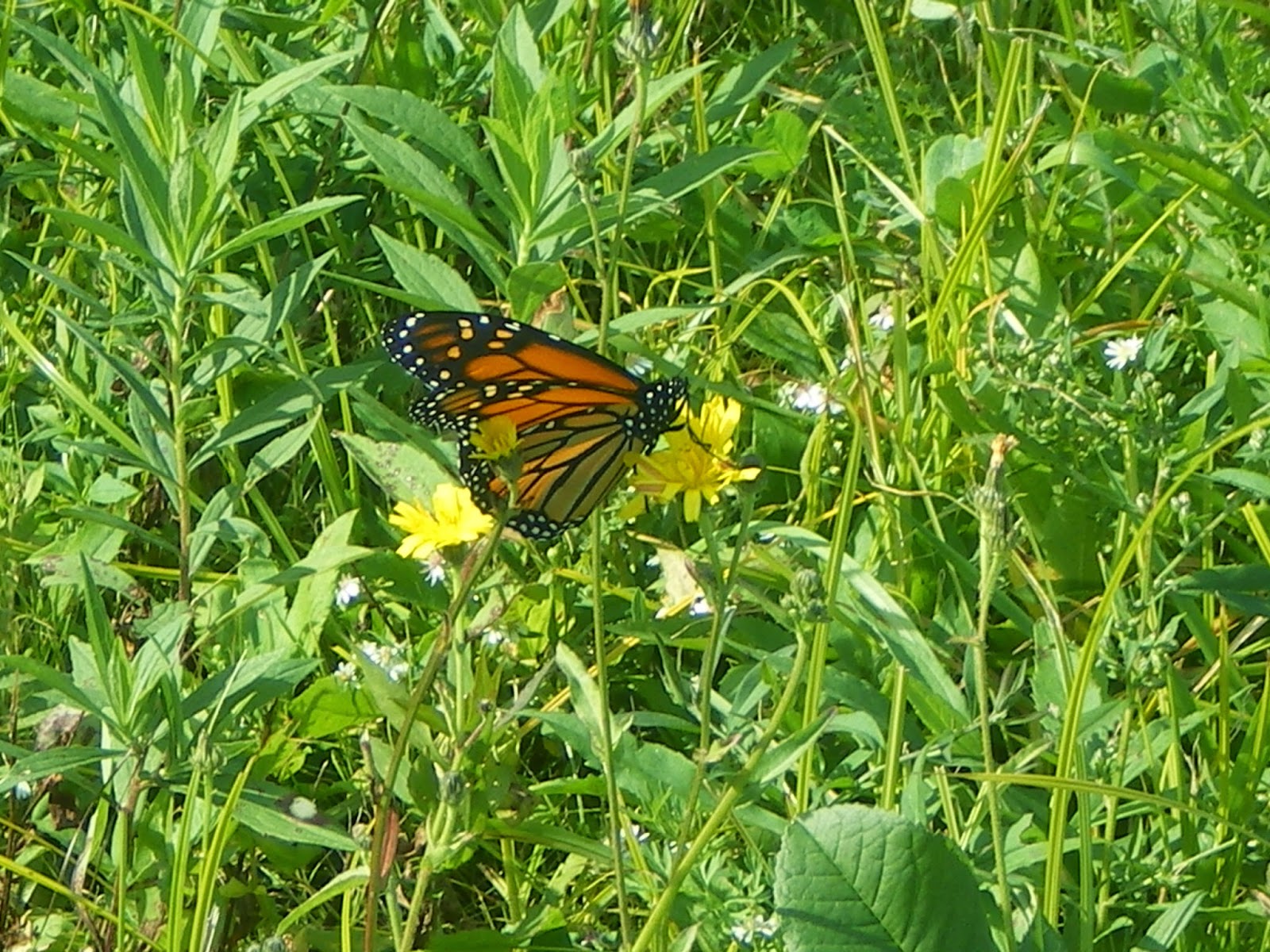
Monarch butterfly count 2014

Several years ago while walking in the pasture, I was impressed by the number of butterflies that welled up as I softly passed.  Black and Tiger Swallowtails, Black and Red Admirals, Viceroys and Monarchs all swirled up like flower petals or Autumn leaves stirred by an unseen wind.  Last year I noticed significantly fewer butterflies (cold, wet Spring followed by a cool wet Summer).  This year, I decided to actually count the numbers I was seeing.
Monarch
 Up until today, the counts rested at five (5) Monarch, three (3) Tiger Swallowtail, one (1) Black Swallowtail, one (1) Black Admiral, and one (1) Red Admiral.  I guess the Monarch migration has finally reached our area because as of 11am, I've counted six different Monarch butterflies.  I don't try to capture or tag them.  Sometimes it's just nice to watch and wonder.
This other butterfly is a Viceroy.  They look a lot like Monarchs however are smaller, don't migrate, and have a slightly different wing pattern from the Monarch.  Watch for and take care of these little flowers of the air.  To learn more <click here>.

Tuesday, August 12, 2014

So Happy, I could just roll in it


In order to keep the pastures from getting chewed to the ground and the girls provided with a continuous source of fresh browse,  the goat kids get moved each week to a new area of the pasture.  Some portions of their grazing areas are lush with grasses.  Some are flush with clover.  It seems however that their favorite areas are those that have honeysuckle, thorny stuff (including thistle, blackberry, and multifloral rose), and poison ivy.
Poison Ivy
I'm glad this makes them happy.  It will eventually remove these noxious plants from the pastures making them more acceptable to other grazing critters. In the meanwhile, a little caution will need to be exercised by Mom.  Happy goats sometimes roll around in the stuff they love so much, coating their fur with poison ivy oil.  Absent mindedly reaching down and giving someone a pat or a scratch, may result in a nasty rash on the arm or hand.  One learns quickly.
***Nice to know: if exposed to poison ivy: wash in lots of soapy, warm water.  Use a soap designed to cut grease, such as Dawn dishwashing soap.  Remember, too, that if it's on your hands it could also be on your clothes.  Tossing dirty clothes in with the rest of the laundry may result in transferring the poison ivy oil onto the rest of the wash.  So keep them separated, again washing in warm to hot soapy water and rinsing thoroughly.
It's hard to keep from scratching but a liberal application of hydrocortisone cream may help relieve the itch.  Other natural remedies include Jewelweed.  This plant grows in profusion in Central New York.  Mashed up and applied directly to the exposed area, Jewelweed is said to help heal the inflammation.

Jewelweed
The old adage: 'Leaves of three, leave them be' is good to know however not always reliable.  The simple, 'If you know know for certain what it is, don't touch it' it probably a better rule of thumb to follow.

more about the treatment for poison ivy exposure can be read here:

Poison ivy treatment tips
Natural methods for the treatment of poison ivy


Sunday, July 14, 2013

New words and the questioning mind

 I love listening to questions from people who really want to know the answer.  These are the folks that once the question is asked, will explore and read and question until they have a satisfactory answer.  Then they ask again. 

While walking the other day, I wondered why certain things are considered more beautiful that others.  I also wondered why there seemed to be a lot of spirals found in nature.  Think about it: rose petals attach to the flower's center in a spiral pattern.  Even something as mundane as a head of lettuce has leaves that attach to the core following a spiral.
Brace yourself.  We're going into the deep end of the pool.

First: the word of the day: fibonacci. The short version: Back around 1200 AD, an Italian mathematician named Leonardo Pisano discovered a sequence that begins with 0 and 1 which is thought of as the 'golden arrangement' found in nature.  Each successive number is made from the sum of the last 2 numbers, like in the sequence, e.g. 0, 1, 1, 2, 3, 5, 8 etc.  As the numbers go up, the space between the last number also increases forming a spiral.  oh, and Fibonacci?  That was his nickname.  It's actually Italian for Son of Bonacci (his dad).
For of those of you who love math or would like to know how all this works out, there are articles published online that work it all out.
So, obviously, human beings don't look much like seashells, but the Fibonacci also applies to us.  Look at your hand.  Think of the fingernail as a unit = 1.  The bone making up the tip of your finger (distal phalanx) would be equal to 2.  The part next to it (middle phalanx) would be equal to 3.  The part nearest the palm (proximal phalanx) is equal to 5.  and so on.  It is the proportions and balance that contribute to what we describe as beautiful.  To read more, I like Boston University's Fibonacci Sequence site.  Always nice to have a little fun when learning something new.


Wednesday, January 2, 2013

Happy New Year from My Happy Acres

Winter has settled on My Happy Acres, putting the land and forest to a nice cool sleep.  As you recall, this last Summer was quite dry so seeing the snows come are a relief to many of us concerned about our wells and ground water reserves.  Besides, it's quite pretty to enjoy either out in it or from a warm window.

I understand that snow is not necessarily everyone's cup of tea but it does serve an important purpose.  Snow protects the ground from evaporation, keeping it warm while harsh winds blow.  Remember those lovely snow flakes?  They start their lives out as a bit of dust, soot, or other mucky bits blowing about in the air.  As water condenses on the surface, ice begins to form, creating the lovely patterns we are all familiar with.  (Want to see some cool pictures?  Go to: http://news.nationalgeographic.com/news/2004/02/photogalleries/snowflakes/ )

As the snow slowly melts, it gently percolates down into the soil, slowly watering and rejuvenating the land.  Deep water tables are replenished over time.  Without snow,  the water tables would dry up along with rivers, ponds, and lakes.  (Want to read more?  See how nature makes snow and how man made snow makers work at: http://adventure.howstuffworks.com/outdoor-activities/snow-sports/snow-maker1.htm)

Everyone enjoys Winter in his own way.  Some like to ski.  Some like to build forts and snowmen.  Snow mobiling is very popular in Central New York and is sometimes a necessity although we are blessed with living on a road that gets plowed semi-regularly.  Personally, we have found that snow shoeing is a nice way to quietly enjoy the snow fall. 
Whatever you decide, enjoy the company of friends and family, and have a blessed New Year.

Wednesday, November 7, 2012

Icy, frosty mornings

Temperatures hovered around 25 F this morning, making it an excellent time to look at the small crystals that covered the pastures and orchards. 
A fog had settled across our area last night.  As the night turned colder, the fog formed crystals on the foliage which is also known as hoarfrost.  One could easily imagine the frost fairies creating these magical scenes.
If you look closely, some plants have tiny hairs across their leaf surfaces.  This allows the plant to continue to thrive when other plants go to sleep for the winter.  An herb called 'Lambs Ear' is a good example of this furry quality.

Another interesting feature is Needle Ice.  Ever note an area in the soil that appears to have been lightly churned just after a freeze?  This could have been the result of the water droplets in the soil freezing into elongated crystals.  These build and force their way through the soil particles.  Those that break the surface look like tiny glass rods or needles.

This picture also shows the power of ice.  These tiny rods also lift and push rocks and other things to the surface.  One can have a cleared field in late summer, only to discover that come Spring it appears that one is 'growing rocks'.  These little crystals can break down walls, bust up roadways, and do all sorts of damage.  Fortunately we have none of those issues so we can just enjoy how pretty they can be.  As a side note, when looking at needle ice, also look for Frost Flowers.  Similar to needle ice, the frost flower forms where the needle ice comes together and curls a bit to form a flower.  If I have the good fortune to find one, I'll take a picture to share with you.

want to learn a little more about soil and ice?  check this out: http://nsidc.org/cryosphere/frozenground/how_fg_affects_land.html

Sunday, October 21, 2012

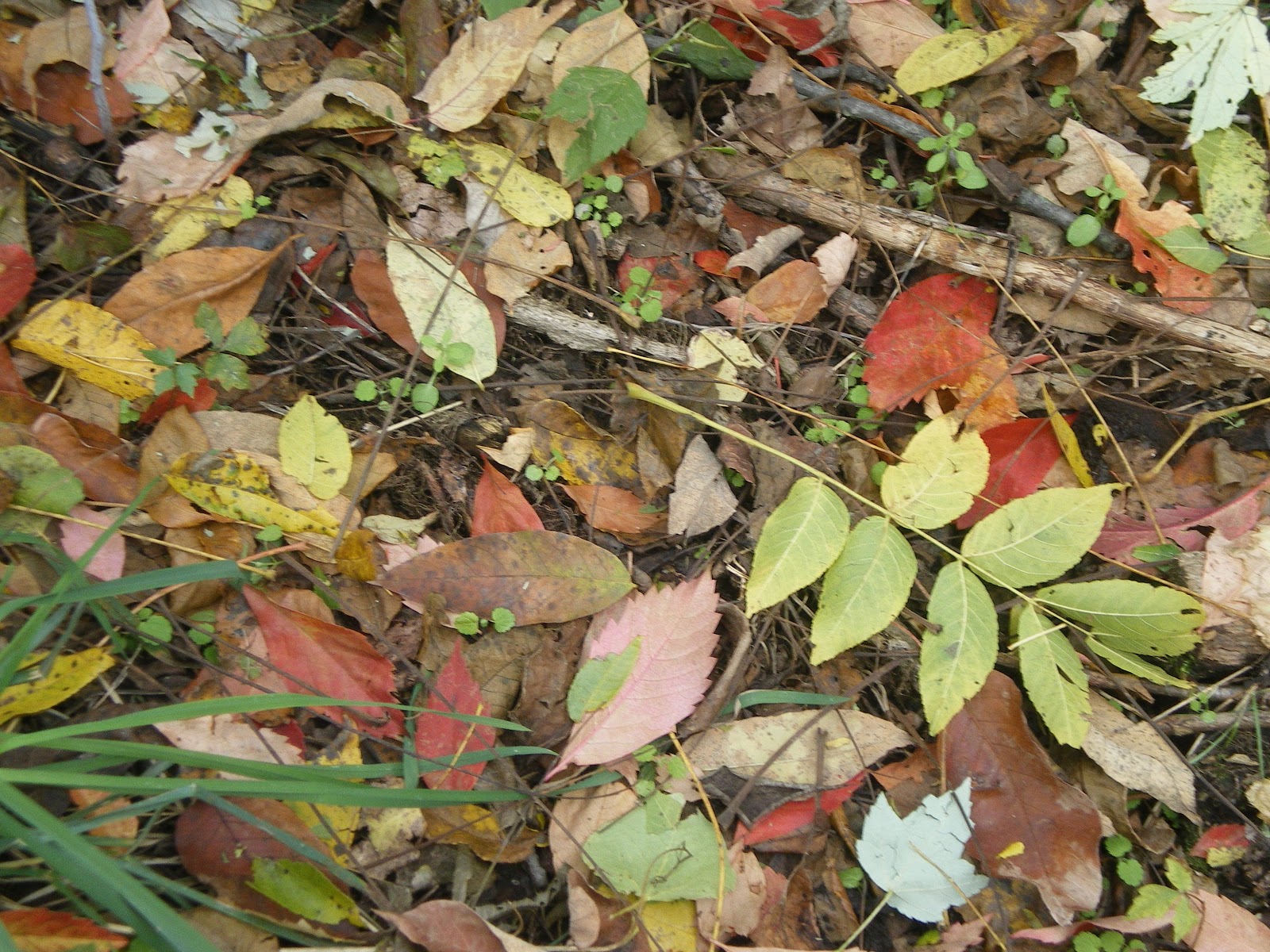
Autumn Leaves

I don't know about you, but I love the changes of the seasons.  Whether it is the sprouting of new life in Spring or the crisp Fall mornings when the brightly colored leaves are tinged with frost, each day offers something new to enjoy.


My grandmother used to tell me that being able to identify trees by their leaf or bark is one of the signs of a well educated person.  I'm still learning the differences.  But this time of year, it's hard to get past the 'oooh! Isn't this pretty?' 
We all assume that when the weather turns cool, the leaves of our Maples and Oaks will gradually start to change color.  By why do they change?  Well, to put it simply, as the days start to get shorter trees and other plants start to slow down and rest.  Rest from what?  All those green leaves were working and producing sugars to help the plant thrive and grow.  When the plant slows down making Chlorophyll, which is what makes them green, sugar production slows and the other colors of the leaf suddenly appear.  (If you want to read more about this, check out Science Made Simple:  http://www.sciencemadesimple.com/leaves.html)

All sorts of critters enjoy the nuts that become ready this time of year.  Black walnuts are hailing down everywhere.  Acorns, too, are coming down by the handful.  Historically the Native Americans would gather the acorns and after soaking them to remove the bitter taste, would dry them so that the acorns could be ground into a flour.  I have been told it tastes a great deal like chickpea flour. 

As you walk along look for the seeds and pods.  Most everyone can identify acorns but do you recognize the conelike seed pods in this picture?  These are from the Tulip Poplar.  When the seedpod dropped from the tree, it looked a great deal like a pine cone.  However after letting it sit and dry, it gradually opened to reveal itself.  


Winter will be here soon.  When you get the opportunity, enjoy what this season offers you.

Monday, September 3, 2012

Natural verses Organic Farming

There is a lot of confusion in the market place regarding the differences in 'Natural' verses 'Organic' farm goods.  Although sometimes the words are used interchangeably, they can be quite different things.  In the US, products marketed as 'Organic' must meet certain guildlines and come from Organic Certified sources.  'Natural' products are not always from certified sources.  So what's the difference? 


In 1990, the Organic Food Production Act was passed by Congress to "establish uniform national standards for the production and handling of foods labeled as “organic.” The Act authorized a new USDA National Organic Program (NOP) to set national standards for the production, handling, and processing of organically grown agricultural products. In addition, the Program oversees mandatory certification of organic production. The Act also established the National Organic Standards Board (NOSB) which advises the Secretary of Agriculture in setting the standards upon which the NOP is based. Producers who meet standards set by the NOP may label their products as “USDA Certified Organic.”

Later in 1995, specific definitions were further outlined to help clarify to the consumer what the 'Organic' label means.  Also at this time, the beginnings of regulations and enforcement came down, providing specific structure for farms and dairies to be certified organic.  These guidelines were finalized in 2000 and the law enacted in 2001.  It can take as much as three years to get certified.  Once completed, the farm or area within the farm is periodically recertified.  If for whatever reason the certification is lost, the farm cannot be re-certified until it once again reaches the required standards and passes thorough inspection.  For example: in Washington state, the use of an unapproved substance may result in a loss of organic certification for 36 months.

Here at My Happy Acres, although we are not currently certified Organic, we believe in and practice sustainable agricultural methods.  We have clean ground water and like many small farmers, do everything we can to maintain its integrity.  Living close to the land is not a fad or catch phase, but is our way of life.

If you are interested in Organic production and are willing to dive into 'the deep end of the pool', Cornell University has some guides that you may be interested in.  These are free to download and have lots of good information outlining the general practices recommended by them.

Saturday, August 25, 2012

Spicing up your life

Did you know that there are over 1000 varieties of pepper?  A typical grocery store may carry a few such as the sweet bell pepper or Jalapeno chili but that doesn't begin to scratch the surface of the flavors and varieties out there. 
Most people don't realize that many of the peppers we enjoy today originated from South America.  We take for granted those wonderful little surprises that make many of the southeast Asia dishes so tasty.  As peppers come into season, you can enjoy them fresh, pickled, dried, roasted, or even frozen for later use.
Some people say that they don't like peppers because they are too spicy.  With over a thousand to choose from, the favors are as varied as the peppers themselves.  The Poblano pepper for example adds a rich spiciness to your dish.  Just a word of warning: the heat can vary from pepper to pepper on the same plant.  Additionally when allowed to red ripen and then dried, the Poblano becomes the chile ancho a popular addition to many Mexican and Central American dishes.

Another popular chili is the Banana pepper.  These are available in both a sweet and hot variety.  We enjoy these pickled as a bright side dish or garnish to our summer picnic table.   One of our favorites is the Cherry Bomb pepper.  These can be amazingly hot.  About  the size of a golf ball, these can be stuffed with cheese or prosciutto to make Poppers that your guests will always remember!

So seek out new varieties of the season's peppers and enjoy the spicy side of life!

For further reading and other fun:
http://www.chilipeppermadness.com/

Monday, July 2, 2012

Dragonflies and Damselflies

Once again I find myself amazed at the number of Species found in our area.  Dragonflies and their cousin the Damselfly thrive where clean water is available to complete their lifecycle and food sources are plentiful.
Eastern Pondhawk dragonfly

According to the League of  Naturalists, at Bear Mountain State park, there are over 400 species of dragonfly and damselfly found in the US, of which about 180 are found in New York!  When many dragonflies hunt, they create a basket with their legs.  As they fly and dart about, they are capturing flying insects which get caught on the barbs of the dragonfly's legs, ensnaring them, for an inflight lunch.  Gnats, mosquitos, moths, and other pests are favorites however will consume a bumblebee or two if the opportunity arises.

When looking out over the western pastures in the early evening, one can see the silvery flash as the last bits of sunlight sparkle off their wings.  The buzzing rattle created during their flight makes it easy to imagine an enchanted world of fairies.


For more information go to:
http://piplon.org/pdf files/DAMSELFLIES AND DRAGONFLIES OF SOUTHERN NEW YORK.pdf
http://www.dec.ny.gov/pubs/74692.html


Friday, June 1, 2012

Today's readings

this morning has had all sorts of interesting stuff to read.

About the Bees:  http://www.hobbyfarms.com/crops-and-gardening/harvest-honey-new-way.aspx
I had wondered about this.  some of the old guys at the orchards said that one should harvest honey in Spring.  in that way the bees have enough to carry them for the winter and the hive will be healthier in the long run.  when I look at how much of the commercial honey is harvested it gives me pause.  Honey has all sorts of good stuff in it including enzymes that boost immunity and aide in wound healing.  to say that giving bees diluted corn syrup as a substitute for harvested honey seems contrary to common sense.  but what do I know?  I have no experience in this.  but I keep reading...

Bees in wild Blackberries
Eggs
On the other hand, something I do have a wee bit of experience with is eggs.  there are so many pluses about eating eggs.  it was nice to see someone write up all these benefits: http://pakagri.blogspot.com/2012/06/10-health-benefits-of-eggs.html


Missy
the day is pretty overcast.  I have my fingers crossed for soft steady rains.