Showing posts with label apples. Show all posts

Friday, September 16, 2016

September, where does the time go?

I'm always a little surprised when I realize that another month has slipped by and we're sailing into a new season.  Summer was very dry this year.  Central New York has areas that have been deemed drought zones, including My Happy Acres.  We've been fortunate that our well hasn't gone dry but we also make an effort to conserve water whenever possible.
The garden was not planted as heavily as last year.  We have lots of plum tomatoes.  Unlike last year, the poblano peppers are doing really well.  We have enough to enjoy fresh yet enough to freeze and enjoy this winter.  When you want to add a flavorful, yet sometimes spicy kick to you meal, substitute the bland green bell pepper with a poblano.  It's a real flavor treat!  (for recipes, check this out.)
Of course, it wouldn't be Summer without fresh green beans and fresh three bean salad.  One of our favorite parts of Summer are all the cool summer salads.  Such a shame to see the season come to an end.  Our dog is also very fond of fresh green beans so I have to be watchful when the bucket is being brought in from the garden.  He gets a few, but only when I give them to him.
The apples are almost ready for harvest.  The Galas should be ready in the next day or two and promise to be extra sweet this year.  Gala apples are one of the choice apples for making traditional apple crisps and sweet apple pies.  They retain their shape, yielding a sweet, lovely flavor to your baked goods.  If you have a favorite apple, get your reservation in soon before they're sold out!

Wednesday, June 22, 2016

Early Days of the rainless summer, 2016

The west coast is on fire.  The Mid- and Southwest are struggling with high temps.  The South and Southeast including Texas are struggling with flash floods.  Here in the Northeast, although temps continue to be relatively mild, we've received nearly half as much rain as we had by this time last year.  Spooky.

On the plus side, the late cold temps in Spring caused many of the blossom heads to drop making culling fruitlets a much simpler task.  The dry conditions add to the fruit drop.  Too much water stress however can cause fruit trees to not bear the following year, so we have to be vigilant.
It's easy to forget that trees need supplemental watering in warmer or dryer weather.  Setting up a sprinkler in the early evening may seem like a great idea however one needs to consider how much competition  for the water your tree may have.  Flowers, grasses, and other trees are all taking up the water being applied.  Additionally, the drier the ground, the more difficult it is for the soil to hold water and not allow it to merely run off.  At My Happy Acres, we start by moistening the soil around the tree before giving each one a long drink.
Determining how much water to apply to each tree is a simple calculation.  Begin by measuring the circumference of the trunk.  Divide this number by 3.14.  This will give you the diameter (D) of the trunk.  Multiply the diameter times ten to get the number of gallons needed (D x 10 = #gal).


Although there are gizmos out there that will allow a user to precisely me asure the amount of water flowing from one's hose, most households produce enough water pressure that using the calculation, diameter times five, will tell you how many minutes of water flow will provide your tree with its water needs.  (D x 5 = Minutes)
Remember that it's important to measure your trees.  Although many of our trees were planted four years ago, some are slow growing and others are more robust.  The Sansa for example are only 1.4" in diameter however the Northern Spy are nearly 3".  The difference is in the variety.  Some grow fast.  Some grow more slowly. 
Take care of your trees and you will be rewarded in the fall with some lovely fruit!


Friday, October 30, 2015

Why cull? (revisited) 2015

Now that the apple harvest is complete, we can revisit what worked, what didn't, where we were successful, where we could have done better.  With a little less than 100 trees, we have the 'luxury' of examining each tree and identify its strengths and weaknesses.  Some trees produced a lot of large healthy fruit.  Some trees were not as prolific.  Some trees, although culled heavily in Spring, should have had a second culling later in the Summer.  How can we tell?  Why cull at all?
Culling or removing smaller fruitlets at an early stage of development, allows the tree to focus it energy on developing fewer, yet stronger, healthier fruits.  Having too many fruits can also cause stress on a tree which can make it more prone to sickness, difficulty in surviving the winter cold, or even prevent it from fruiting the following year.  How many times have we heard people say: 'My tree produced 100s of apples last year, but this year we were lucky to get a handful!'
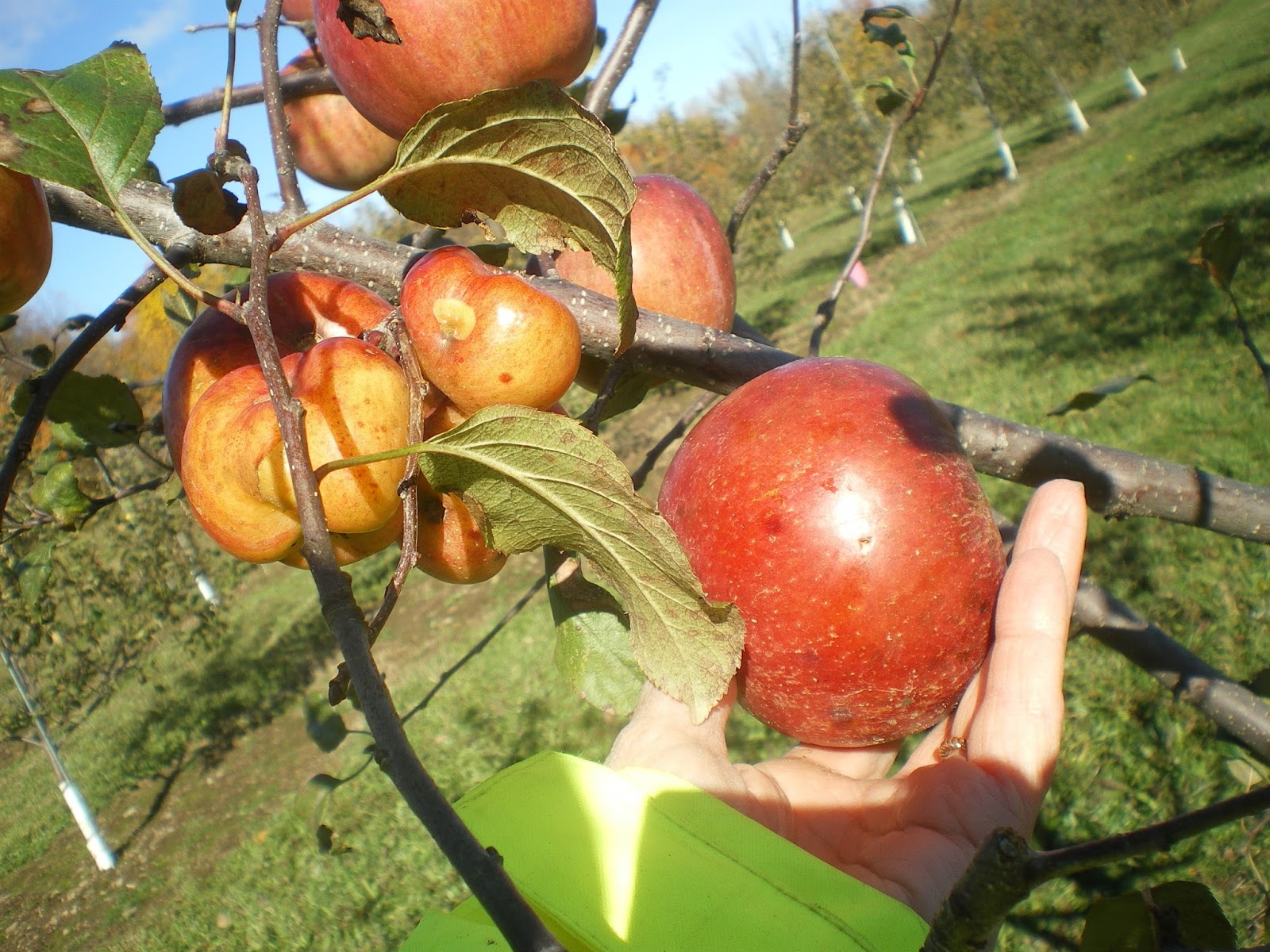
As an experiment, last Spring we left a few fruit clusters to develop as they would normally, then compared the results to branches that had been gleaned.   In the above photo you can clearly see the results: the unculled fruit clusters were significantly smaller and frequently misshapen.  The taste was fine however unattractive in appearance.
Some people are put off by fruits that don't look like something out of a picture book.  There are also those folks that will only eat one variety of apple.  Those conversations usually begin with, 'we only eat...'  This is very unfortunate for all of them because they miss out on all the variety and flavors available. 
To broaden your experience, next time you're at the market try this: purchase one of each of a variety of different apples: Jonathan, Empire, Granny Smith, and Fuji is a good selection to start with.  Also select a mild cheese such as Monterey Jack or mozzarella to nibble on between tastes of each slice of apple.  Remember: the purpose is to taste and think about the flavors.  A sweet apple may be good to eat out of the hand, but a slightly tart apple may be better in salads.  There are hundreds of varieties with only a handful available at your local market.  Once you've tasted the first four, select a new grouping and repeat the taste test.  Try not to do more than four, otherwise your taste buds may get a little overwhelmed.  Who knows?  You may discover some new favorites!

Saturday, October 10, 2015

Apple Harvest, next round

You want to taste something amazing?  This morning we harvested our Jonagold apples.  The Jonagold is a cross between the Golden Delicious and the Jonathan apples.  This red apple has the crisp, sweet yet slightly tart flavor that is terrific to eat out of the hand or for caramel apples


For those that like the Honey Crisp but don't like the sky high prices that are usually associated with this specialty apple, the Jonagold may be just the right apple for you!  Try some today!  You may discover a new favorite.

Sunday, September 6, 2015

When to Harvest Apples, 2015


‘So when do you harvest your apples?’  That’s how the conversation started as a neighbor peered over the fence at the slowly ripening fruit.  ­­My Happy Acres offers over a dozen different apple varieties.  Some apples are good for pies.  Some are good for sauce.   Some are delicious to eat right off the tree.  So when do you harvest?
Just as there are different apples for different purposes, there are different harvest times for different apples.  As much as we wish that we could firmly control the growth and development of our trees, there are so many variables that influence fruit development.  We can get a rough estimate based on variety, but still need to check and monitor before picking the fruits.  Rain, heat, humidity, insects, even bird activity can shift harvest dates.  So when do you harvest?  Let me share a tip and a trick with you: ignore the calendar, check your fruit.
Cortland
Although some folks will tell you that when the apples are red, you should pick the fruit.  Well, what do you do when you have a variety that doesn’t normally turn red?  Jonagold, Fuji, and even some Courtland frequently have fruit that doesn’t turn red but appears green at harvest time. An easy way to determine if your apples are ready to harvest is to select a sample apple from the tree in question and cut it in half to expose the endocarp or seed area of the apple.  
Sansa on left is ready to pick; Cortland on right needs another week or two.
Take a close look at the pips or seeds.  If they are white, light tan, or have white tips, the apples are not ready for harvest.  Our Sansa trees are ready to be picked.  First developed by an international team, the Sansa is a cross between the Gala and Arkane apples giving it a sweet flavor and fine texture. 
These little trees are not particularly attractive, nor very productive. What they lack in looks, they make up for flavor.  Unlike other apples, the Sansa is slow to turn brown when sliced.  This makes the Sansa an excellent choice for salads or slices.


Saturday, June 27, 2015

Spring slowly turns to Summer, 2015

The chicks are loaded in their carrier and ready for a new day out in the garden.  Provided that the weather stays mild, we'll head out.  Then, while Mom does her weeding, the chicks can explore and, hopefully, stay out of trouble. 
We're not troublesome...


Getting a snack before going outside.
 And weeding needs to be done.  With all the good rain we've had lately, the garden is lush but the weeds have also had a nice deep drink.  As the unwanted seedlings are removed, I drop them into a bucket and tote them out to Chickenland to provide the Ameraucanas with some extra treats.  They get plenty of greens, but everyone knows the stuff in the bucket always tastes so much better!

Don't think of them as weeds.  Think of them as chicken snacks.
Speaking of snacks, I am periodically reminded that we live in the country and all sorts of wild things creep and crawl around us.  Many people have a fear of snakes but I count my blessings that they help keep the mice at bay and help take care of an abundance of frogs this Spring has brought us.
The orchards are doing well this year.  We've carefully culled the apples and other fruit trees to encourage healthy growth of the remaining fruits.  Those trees that are contained within protective fencing, continue to grow tall and strong.  Unfortunately, those trees that are not fenced have been subjected to heavy browsing by our deer population.  This little cherry tree, for example, the day before was full and lush.  It had all the appearances that we would have some nice sweet cherries in a few more weeks.  Last night, the deer came.  In what only took a few minutes, left the little tree nearly leafless.  I don't know if it will ever recover or suffer from the shock causing it to either die or not produce fruit for a few years.
 Culling apples takes a long time.  We have nearly 100 trees.  Each one is carefully reviewed.  Variety and when planted is taken into account.  When an apple tree flowers, each five flower cluster can produce five apples.  If left alone, the tree will attempt to feed each of these fruitlets leading to stress on the developing tree and small uneven apples at harvest time. 
 By removing four of the five smaller fruitlets, the fruit tree focuses its energies on the single fruit and growth of the tree.  This leads to a healthier tree and larger, more uniform apples.

A lot can happen between now and harvest time.  For now we hope and pray for this year's crop.

Thursday, May 14, 2015

Apple Blossom time 2015

Been out walking in the orchard this morning.  Can't begin to tell you how nice it is to listen to birds chirping while strolling down the aisles of flowering fruit trees.  We had a touch of frost last night.  Not enough to knock the blossoms off, just enough to singe them (think freezer burn).
Because different varieties of apple tree have different picking times, one can walk the orchard and notice that some trees are just past peak bloom while others are just starting to open their flowers.   When enjoying such an abundance of flowers it's hard to resign ones self to the fact that one can't let ever blossom make an apple.  The tree will be healthier and the fruit will be larger and tastier if the tree is only focused on growing fewer apples.  How to decide?  ahh that's a decision for another day.  For now it's time to enjoy the lovely fragrance and the fragile delicate flowers.

Sunday, May 10, 2015

Something nice to smile about

"I'm really not a morning person," I overheard someone lament the other day, "I can't seem to get myself out of bed before 10am."
10am!? I thought.  I can't imagine staying in bed so long.  At dawn the deer and other animals are out grazing.  The beasties are all ready for breakfast, yet anxious to go outside to graze and play.  Early morning light seems softer than later in the day.  Temperatures are cool, so the bugs seem minimal.

Out in the pasture, the girls are finding all sorts of tasties to enjoy.  The chickens are snacking on fresh grass and creepy crawlers.  The goats are delighted by the wide selection of things growing out there.  Some folks think that the only thing grazers eat is grass.  Each animal type, cows, horses, goats, even pigs, have different dietary needs, so the pasture needs to offer graze and browse to fill those needs.  A pasture suited for goats may be inappropriate for dairy cows, and visa versa.  Personally, I like the variety of ever changing flowers.
 Many parts of the pasture are carpeted with wild strawberry blossoms.  If we get good rains, the resulting fruits are large, plentiful, and delicious.  If rain comes sparingly, the wild strawberries are small, dry, and very seedy.  You can guess what we prefer.
Meanwhile out in the orchard, the apple trees are all doing well.  While dormant, they were pruned and checked for issues such as insect egg sacks.  I'm pleased to say, that so far so good.  We have a bounty of pink tips promising lovely flowers later in the week.


Monday, October 27, 2014

What to do with all those apples

This has been a really good year for apples.  Not too hot.  Not too cold.  Not too wet.  Not too dry.  Pest management was minimal.  Trees grew strong and healthy.  This is the kind of year that orchardists and tree managers look forward to.

So what to do with all those apples:
Before immediately making pies, what kind of apple are you comtemplating?  Put simply, some apples are better suited to cooking than others.  Braeburn, for example, makes a wonderful apple butter.  As this apple cooks, it easily breaks apart creating a delicious sauce and, with a little effort, makes a lovely apple butter.
Other apples such as Fuji or Jonagold hold their shape making them perfect for pies or baked apples.  When peeling and prepping pie filling, don't worry if you get a little carried away.  After making the first pie, put just enough filling for another in a press and seal (Ziplock type) freezer bag.  After removing the air, lay the sealed bag in foil pie tin, and freeze.  The pie filling will freeze in the shape of the pie tin.  When ready to use, remove the pie tin shaped filling and place in a prepared pin pan, covering with pie dough, finishing normally.   Easy-peasie.

Another good idea is a nice alternative to snack chips: dried apples.  Peel and slice the apples about 1/4" thick, then soak for about 2 minutes in a citric acid solution (2 T citric acid to 1 quart water).  Available at most health food stores, citric acid is a nice alternative to sulfur and will keep the fruit from turning dark while adding Vitamin C.  Place treated slices in the dehydrator for about 10 hours (135 F degrees).   I like dried apples crisp and slightly tart, so this is perfect.  When ready, place the apple slices into a air tight container and seal.
As you're enjoying these, remember: as good as these are, whether you are eating an apple straight off the tree or nibbling at them one slice at a time: ten apple slices can equal an entire apple.  Moderation is the clue.  (I know: no fun.)

For ideas and more info: read here.


Thursday, October 2, 2014

Harvest time 2014

Patiently we watched and waited.  Every few days, we walked the orchard, monitoring the baby trees for signs of growth and possible pests.  With sharpened tools, we selectively pruned, gently spreading limbs to uncross and grow healthy.  First year fruits were removed to allow the baby trees to put their energy into growing strong.  This year we allowed some of the little trees to produce fruit.
Gala, Fuji, and Cortlands were very productive, resulting in large, lovely apples, beckoning to be eaten straight off the tree.  The Honey Crisp trees produced apples, however perhaps need another year or two to mature before they will be a marketable size.
Helper puppy guarding the pick sack

As far as I'm concerned, they were all perfect size for making apple butter and, above all,
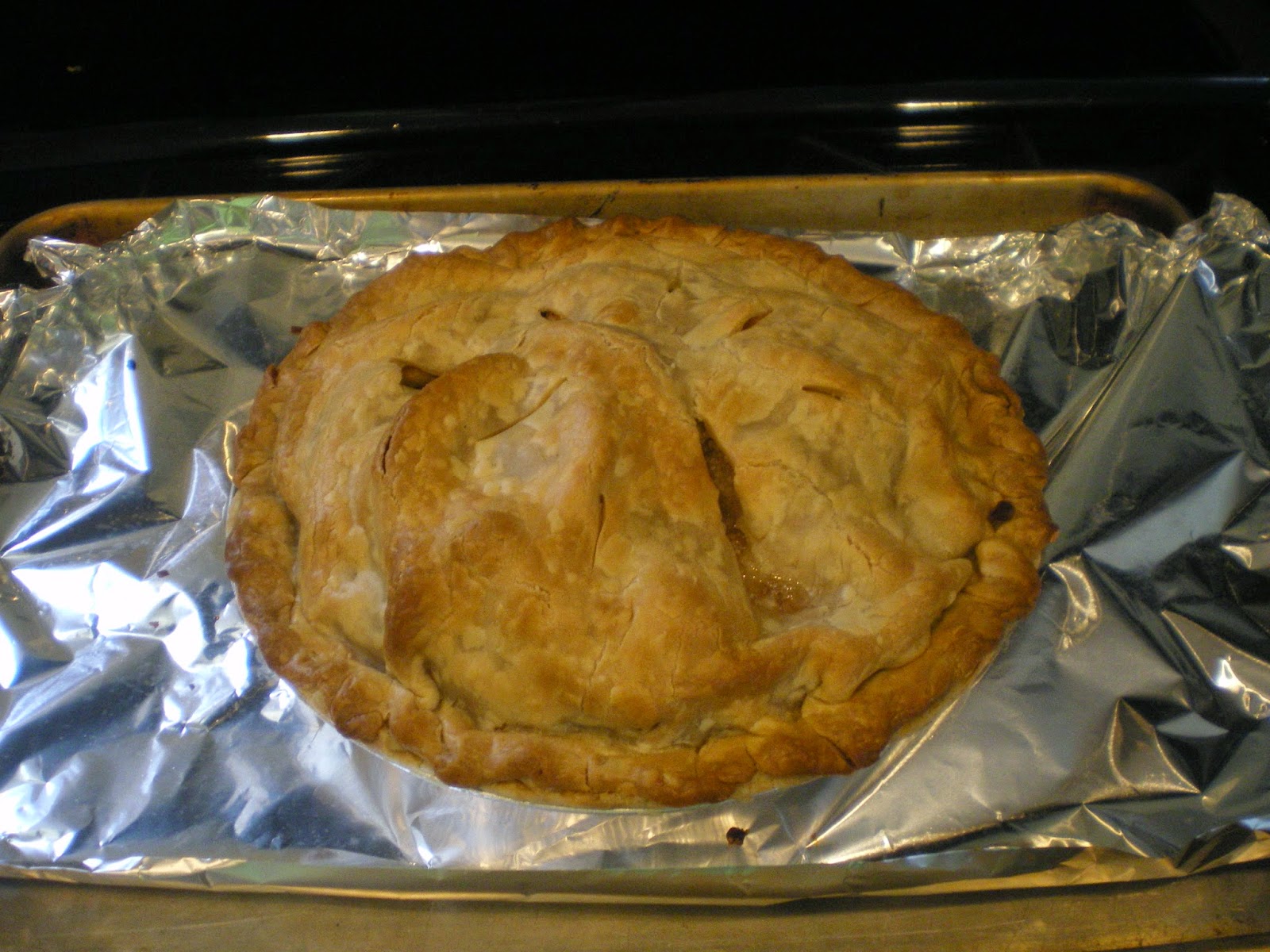
mmmmmmmmmm, pie...
apple pie.  If you're looking for some good recipes to use your apples in, < click here>.  Remember, keep it simple.  Enjoy a fresh fall apple today!