Showing posts with label Fruit. Show all posts

Friday, September 16, 2016

September, where does the time go?

I'm always a little surprised when I realize that another month has slipped by and we're sailing into a new season.  Summer was very dry this year.  Central New York has areas that have been deemed drought zones, including My Happy Acres.  We've been fortunate that our well hasn't gone dry but we also make an effort to conserve water whenever possible.
The garden was not planted as heavily as last year.  We have lots of plum tomatoes.  Unlike last year, the poblano peppers are doing really well.  We have enough to enjoy fresh yet enough to freeze and enjoy this winter.  When you want to add a flavorful, yet sometimes spicy kick to you meal, substitute the bland green bell pepper with a poblano.  It's a real flavor treat!  (for recipes, check this out.)
Of course, it wouldn't be Summer without fresh green beans and fresh three bean salad.  One of our favorite parts of Summer are all the cool summer salads.  Such a shame to see the season come to an end.  Our dog is also very fond of fresh green beans so I have to be watchful when the bucket is being brought in from the garden.  He gets a few, but only when I give them to him.
The apples are almost ready for harvest.  The Galas should be ready in the next day or two and promise to be extra sweet this year.  Gala apples are one of the choice apples for making traditional apple crisps and sweet apple pies.  They retain their shape, yielding a sweet, lovely flavor to your baked goods.  If you have a favorite apple, get your reservation in soon before they're sold out!

Friday, October 30, 2015

Why cull? (revisited) 2015

Now that the apple harvest is complete, we can revisit what worked, what didn't, where we were successful, where we could have done better.  With a little less than 100 trees, we have the 'luxury' of examining each tree and identify its strengths and weaknesses.  Some trees produced a lot of large healthy fruit.  Some trees were not as prolific.  Some trees, although culled heavily in Spring, should have had a second culling later in the Summer.  How can we tell?  Why cull at all?
Culling or removing smaller fruitlets at an early stage of development, allows the tree to focus it energy on developing fewer, yet stronger, healthier fruits.  Having too many fruits can also cause stress on a tree which can make it more prone to sickness, difficulty in surviving the winter cold, or even prevent it from fruiting the following year.  How many times have we heard people say: 'My tree produced 100s of apples last year, but this year we were lucky to get a handful!'
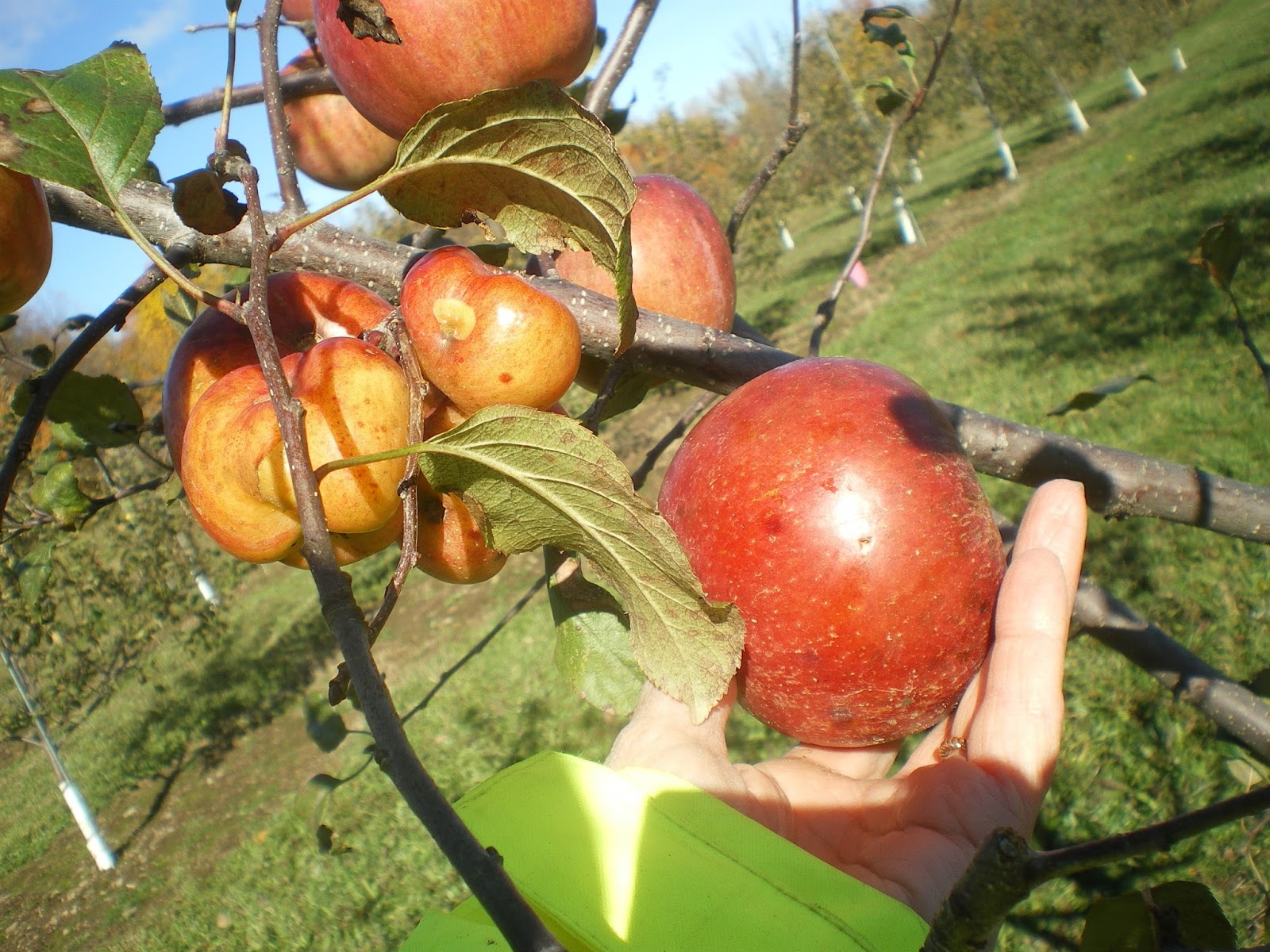
As an experiment, last Spring we left a few fruit clusters to develop as they would normally, then compared the results to branches that had been gleaned.   In the above photo you can clearly see the results: the unculled fruit clusters were significantly smaller and frequently misshapen.  The taste was fine however unattractive in appearance.
Some people are put off by fruits that don't look like something out of a picture book.  There are also those folks that will only eat one variety of apple.  Those conversations usually begin with, 'we only eat...'  This is very unfortunate for all of them because they miss out on all the variety and flavors available. 
To broaden your experience, next time you're at the market try this: purchase one of each of a variety of different apples: Jonathan, Empire, Granny Smith, and Fuji is a good selection to start with.  Also select a mild cheese such as Monterey Jack or mozzarella to nibble on between tastes of each slice of apple.  Remember: the purpose is to taste and think about the flavors.  A sweet apple may be good to eat out of the hand, but a slightly tart apple may be better in salads.  There are hundreds of varieties with only a handful available at your local market.  Once you've tasted the first four, select a new grouping and repeat the taste test.  Try not to do more than four, otherwise your taste buds may get a little overwhelmed.  Who knows?  You may discover some new favorites!

Sunday, September 6, 2015

When to Harvest Apples, 2015


‘So when do you harvest your apples?’  That’s how the conversation started as a neighbor peered over the fence at the slowly ripening fruit.  ­­My Happy Acres offers over a dozen different apple varieties.  Some apples are good for pies.  Some are good for sauce.   Some are delicious to eat right off the tree.  So when do you harvest?
Just as there are different apples for different purposes, there are different harvest times for different apples.  As much as we wish that we could firmly control the growth and development of our trees, there are so many variables that influence fruit development.  We can get a rough estimate based on variety, but still need to check and monitor before picking the fruits.  Rain, heat, humidity, insects, even bird activity can shift harvest dates.  So when do you harvest?  Let me share a tip and a trick with you: ignore the calendar, check your fruit.
Cortland
Although some folks will tell you that when the apples are red, you should pick the fruit.  Well, what do you do when you have a variety that doesn’t normally turn red?  Jonagold, Fuji, and even some Courtland frequently have fruit that doesn’t turn red but appears green at harvest time. An easy way to determine if your apples are ready to harvest is to select a sample apple from the tree in question and cut it in half to expose the endocarp or seed area of the apple.  
Sansa on left is ready to pick; Cortland on right needs another week or two.
Take a close look at the pips or seeds.  If they are white, light tan, or have white tips, the apples are not ready for harvest.  Our Sansa trees are ready to be picked.  First developed by an international team, the Sansa is a cross between the Gala and Arkane apples giving it a sweet flavor and fine texture. 
These little trees are not particularly attractive, nor very productive. What they lack in looks, they make up for flavor.  Unlike other apples, the Sansa is slow to turn brown when sliced.  This makes the Sansa an excellent choice for salads or slices.


Monday, October 27, 2014

What to do with all those apples

This has been a really good year for apples.  Not too hot.  Not too cold.  Not too wet.  Not too dry.  Pest management was minimal.  Trees grew strong and healthy.  This is the kind of year that orchardists and tree managers look forward to.

So what to do with all those apples:
Before immediately making pies, what kind of apple are you comtemplating?  Put simply, some apples are better suited to cooking than others.  Braeburn, for example, makes a wonderful apple butter.  As this apple cooks, it easily breaks apart creating a delicious sauce and, with a little effort, makes a lovely apple butter.
Other apples such as Fuji or Jonagold hold their shape making them perfect for pies or baked apples.  When peeling and prepping pie filling, don't worry if you get a little carried away.  After making the first pie, put just enough filling for another in a press and seal (Ziplock type) freezer bag.  After removing the air, lay the sealed bag in foil pie tin, and freeze.  The pie filling will freeze in the shape of the pie tin.  When ready to use, remove the pie tin shaped filling and place in a prepared pin pan, covering with pie dough, finishing normally.   Easy-peasie.

Another good idea is a nice alternative to snack chips: dried apples.  Peel and slice the apples about 1/4" thick, then soak for about 2 minutes in a citric acid solution (2 T citric acid to 1 quart water).  Available at most health food stores, citric acid is a nice alternative to sulfur and will keep the fruit from turning dark while adding Vitamin C.  Place treated slices in the dehydrator for about 10 hours (135 F degrees).   I like dried apples crisp and slightly tart, so this is perfect.  When ready, place the apple slices into a air tight container and seal.
As you're enjoying these, remember: as good as these are, whether you are eating an apple straight off the tree or nibbling at them one slice at a time: ten apple slices can equal an entire apple.  Moderation is the clue.  (I know: no fun.)

For ideas and more info: read here.


Friday, August 9, 2013

Enjoying the summer's bounty

Not everyone has the good fortune of a florishing garden or local orchards producing lushious peaches and apricots.  Whenever possible support your local farmers by shopping farmers' markets and buying direct.

It's blackberry time at My Happy Acres.  We have both seeded and seedless varieties.  Large, full of juice, and as sweet as summer, blackberries are delicous in cobblers, served over ice cream, or just by the handful.  Our favorite way to save the taste of summer, is to either freeze the berries for later use or to make jam.  The house was filled with the mouth watering aromas of both apricot (from a local orchard) and blackberry jams.
Of course when out picking the wild berries, some helpers are more help than others (as the puppy helps himself to another mouthful of ripe low growing berries).  Remember: those thorns can be small and hard to remove.  Showing a little caution and reserve can be rewarded with buckets of berries!


Sunday, June 9, 2013

Life a little sweeter

Earlier in the week I went freezer diving and pulled out six (!) large Ziplocks filled with frozen blackberries.  Last year was a perfect year for wild blackberries.  While many other plants suffered in the heat and dryness, the blackberries thrived.
After enjoying bowl after bowlful, it was time to rinse the bounty and stock it away for another time.  Unlike the berries one buys at the store, our berries were not soaked in sugar before being put away.  Rather, the berries were rinsed then spread out on a cookie sheet prior to freezing.  This allowed each fruit to freeze separately, maintaining it's shape and juice.  The frozen berries are then vacuum sealed before being returned to the freezer until ready to use.

My general rule of thumb when preparing fruits or vegetables is less is more.  When making jam, focus on the fruit.  Our Blackberry jam has only three ingredients: Blackberries, sugar, and pectin (to aide in setting the jell).  One of my favorite recipes can be found at Food.com.  The only change in this recipe is whenever making jam I use a 1 to 2/3rds ratio fruit to sugar.  This creates more of a fruit flavor to the jam however feel free to adjust it to suit your pallet.

Seeds

What slows people down from making their own jams are the seeds.  No one really likes to have the smooth creamy texture of good jam interrupted by a stony seed pellet.  This is easy to remedy.  First of all, put away the food processor.  All this does is grind up the seeds to the consistency of sand making them harder to remove. 
By first mashing the heated fruit with a potato masher, then later mashing and sieving the hot pulp through a food mill, one will render out more of that delicious pulp and filter out the pebbly seeds.  For those that start with seedless fruit (a time saver), after processing through the food mill, set aside the remaining pulp in the refrigerator for an interesting fruit spread.  It won't keep as long as the processed jam (unless, of course, you freeze it), but it's a pure fruit change from sugared spreads.

Like fruit pies, feel free to mix and match fruit combinations when making your jam.  Concord and blackberry blend very nicely as does strawberry with blackberry.  Whatever your favorite, I'm sure you'll find that your store bought jam will pale by comparison to that lovely fresh taste from garden to kitchen.


For some special Tips on Jam making, (click here)

Thursday, May 16, 2013

A time to plant

Although many people seem to believe that managing an orchard begins and ends with picking the fruit, there is more to it than that.  Farming, as with all projects that are worth doing, is a job that requires planning for the future.  Some plans are short term such as weeding, watering, cleaning, and mowing.  Others are longer term such as laying out the garden (three to four months), building and preparing the animal barn for its occupants (six to eight months), and planting and caring for the trees (two to ten years).
Every day we walk the orchard and examine the trees.  Other than deer and other varmints looking for snacks, we watch for signs of disease or other issues so that they can be taken care of promptly.  Think of it this way: when do you take care of a cold?  If you take care of yourself when you only have the sniffles, you'll recover faster.  If you wait until it has turned into pneumonia, you may be in store for a much longer recovery (not to mention all the folks you've now spread the germs to). 

Crab Apple blossoms
At My Happy Acres, we offer a  wide variety of apples and cherries.  As we plant we consider when each of these varieties will be at their best when picked.  We also think about which varieties may need a little help to pollinate.  Not all fruit trees are self pollinating but need another variety to help them along in the process.  Some orchards take the extra step and plant crab apple trees to aide in pollination.  We're fortunate that we have enough flowering varieties at this time that crab apple trees are not necessary.  That said, I still feel that crab apple trees can be quite pretty.  I also have fond childhood memories of candied crab apples on the Thanksgiving table.

News from Chickenland: As the weather warms, we've been thinking about the best way to put the girls out to graze and at the same time, keep them safe from preditors.  Rat snakes are good to keep the rodent population in check, however wouldn't hesitate if a tasty chick blundered into them.  A passing hawk may be on the watch for rabbit, but a hen will do if spotted. 
The girls in the yard are safe for now, but stay tuned!  A chicken adventure is on the horizon.


Friday, May 10, 2013

Spring planting

For those of us who are fortunate enough to live in an area that is well drained and enjoying moderate temperatures, this is the time of year where we can be found out in our fields and orchards, preparing for another season.
Cherry blossoms
The fruit trees are all coming to blossom.  As one walks along the lane, the air is full of its delicate fragrance.  The cherry trees are a-buzz with all sorts of different types of bees.  I'm going to keep my eyes open this summer and see how many different varieties I can identify.

Apple blossom
The new apple trees fared pretty well this last winter with only a minor amount of deer damage.  In order to deter them from nibbling the new buds, we've found that hanging bars of perfumed soap or suspending fresh dryer sheets from the limbs works remarkably well.  To discourage the rabbits and voles from eating the bark around the trunks of the trees, spiral plastic shields wrap and protect each sapling.

We're continuing to plant more trees.  Over the next few days we're expecting to plant 40 more saplings.  It's remarkably satisfying to help things grow.  Whether we're talking about fruit trees, the garden, or the little chicks each has its own needs to grow big and strong.  With a little care and attention, everyone grows happy and healthy.

Speaking of chicks, everyone was transferred out to the nursery box in the mudroom yesterday afternoon.  Dingy has taken on the big sister role and seems to appreciate the company.  Soon after the little chicks arrived, I peaked in on them to see how everyone was getting along.  I was happy to see that Dingy had gathered up the chicks under her wings, pulling them close and safe as they turned in for the night.

Moma Dingy and one of the fuzzyballs

Thursday, April 25, 2013

Spring chores

A small dent was made in the list of Spring To Do's.  When the rain isn't coming down is sheets and buckets, it's rather nice to get outside and take care of business.
The daffodils are springing up every where the soil is rich and moist.  Last year we found some growing along the Northwoods drainage ditch.  Although we left most of them to enjoy the next year, we did dig up a few large bulbs to replant along side our front walkway.  The walkway bulbs will probably be blooming around the time those in the woods start to fade.

The garden continues to expand.  We're doing our best to keep it from getting too large and unmanageable, remembering first that we other things that need our attention besides the garden.  Throughout the winter, we set aside the chicken leavings to mellow and compost.  This was periodically turned over until, finally, the day came that we could use it on our gardens.  Big fleshy worms tumbled out by the shovelfuls as we carted and dumped wheelbarrow after wheelbarrow out where the tomatoes and green beans will call home.  Composting may not be romantic but it is certainly gratifying to know that one's soil amendments are so rich and healthy.
 Side note:  when composting, if the pile has been turned regularly, and given enough water and air, it should not smell sour or stinky but rather loamy or like wet dirt.  According the Farmer's Almanac, It takes between 45 and 60 days for chicken manure to compost, depending on conditions and it's always a good idea to blend it with other amendments such as plant material and top soils. 


Saturday, September 29, 2012

Apple Picking time

What a beautiful weekend to go apple picking!  The apples are luscious and ready for picking.  Starting in late August through early November, apples ripen and become ready for harvest.  Some of these are good eating apples, while others make wonderful pies and desserts.  What is the difference?

When chosing an apple that will be cooked, consider if it will retain its shape.  Also consider if the fruit has a nice balance of tartness to sweetness.  Our family prefers Granny Smiths or Cortlands for pies and tarts however the Ida Red is also an excellent choice.  For those that like a sweeter all purpose apple, the Golden Delicious has a nice flavor.
There are hundreds varieties of apples.  Low in calories yet high in fiber and flavonoids, there is a grain of truth in the old maxim, 'An apple a day, keeps the doctor away.'  Recent research suggests that a diet including apples could be benefitial in preventing cancer and other maladies.  All I know for sure is nothing beats an afternoon spent with your family picking apples in the clear Fall air.

Except maybe a fresh, warm pie...

Fall  Apple Pie

6 to 8 tart apples, peeled, cored, and thinly sliced (about six cups)
3/4 cup sugar
2 Tbsp Tapioca pearls (dry tapioca)
1/2 tsp ground cinnamon
1 tsp Nutmeg
2 Tbsp lemon juice (keeps the apples from turning brown and adds a wee kick to the flavor)
chilled butter
Pastry for 2 crust 9" pie (it's okay to cheat: Pillsbury makes a wonderful frozen crust for those of us who are pastry impaired)

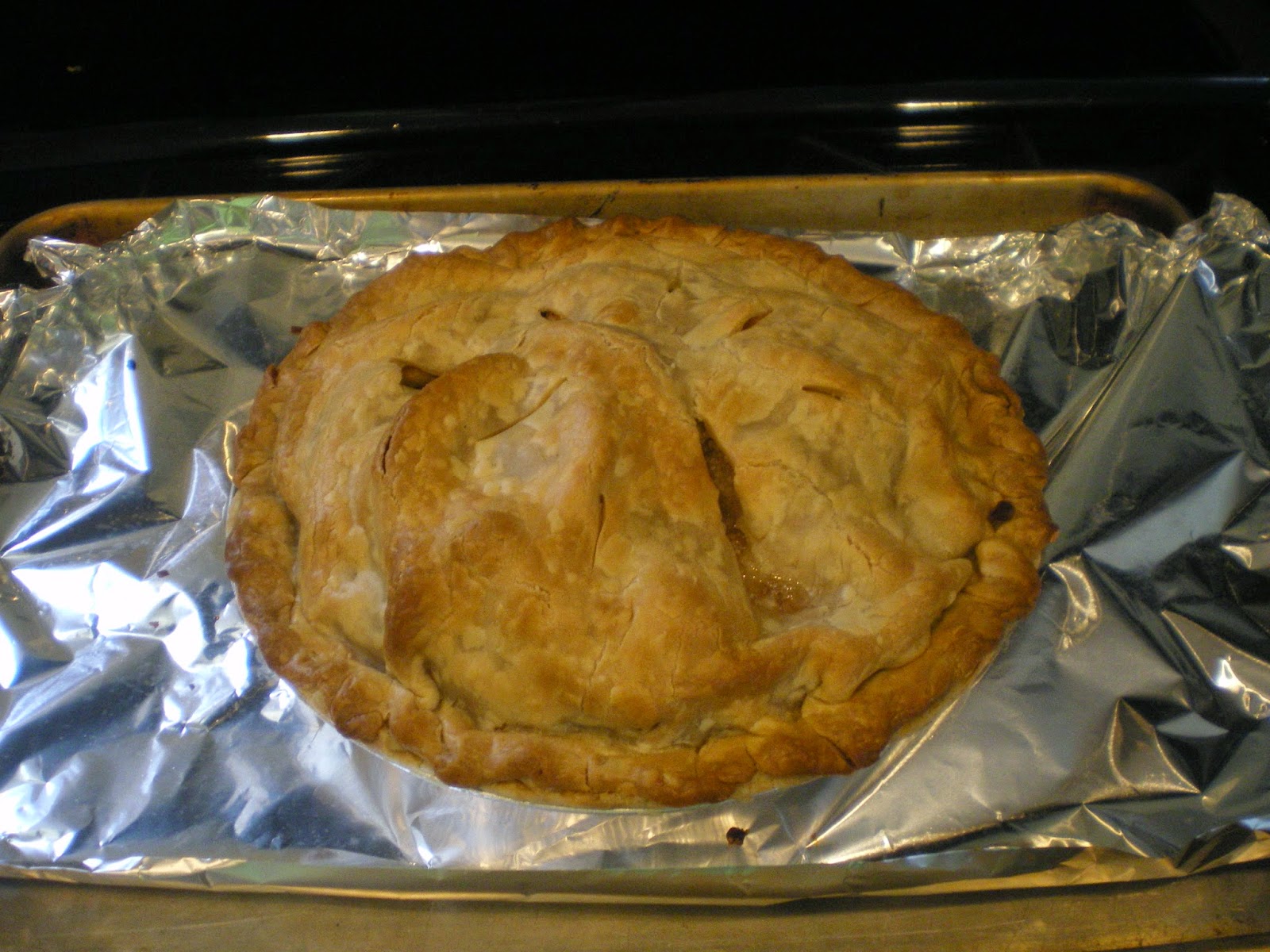
Preheat the oven 400F degrees.  Combine the filling ingredients, coating the apples well.  Spoon the apple mixture into the pie shell, dot with butter, then apply the top crust to the pie.  Be sure to cut a few vent holes in the top so the pie can breath while it cooks.  Bake at 400F for about 50 minutes or until done. 

This simple filling can be used for a variety of desserts.  If you want to kick it up a notch, add 1/2 cup dried cherries or cranberries to the apple mixture.  Remember: the dried fruit will help soak up some of the liquid, so you may want to slightly decrease the amount of dry Tapioca.  Enjoy!


Thursday, July 19, 2012

Water, Hot weather, and helping things grow

It has been an amazing week!  The weather has been very hot and very humid, which turns out to be just what the garden has been wanting.  Squash, tomatoes, and beans are all producing a bounty of fruit.  In the coming weeks we will need to watch the amount of rain coming through and provide supplemental watering when necessary.

Yellow Beans
 The beans were in full flower last Monday.  The yellow beans had these lovely white flowers.  The green beans had a profusion of purplish blue flowers.  We staggered planting our beans so we should be harvesting fresh beans for quite some time.  As a side note: if you have a little open space, don't hesitate to plant a few bean seeds.  They're low maintenance and add nitrogen to the soil.
Green Beans
 We have several different types of Summer and winter squash.  Our summer squash include pattipans and Papaya squash.  Both of these varieties have a delicate flavor and are favorites with the kids.  The pattipans look like yellow flying saucers.  Papaya squash has a slightly sweet flavor and is a tasty addition to stir fries. 

Papaya squash
So much of the country is suffering from drought.  Although where we are located we have not had the usual rains, we count our blessings that it is not as bad as it is in other places.  One of the first things we noticed comparing last year to this, was our cucumbers. 

Given normal circumstances, the cucumber vines should be around four feet long by now. 
Supplimental watering has helped however the extreme heat (day and night) had dried the soil and stressed the plants.  They are currently stunted at about a foot tall.  The plants are still producing however our crop may not be as abundant as in previous years.

The tomatoes are thriving in the heat.  The extra water we provide will keep the plants from taking water from the fruits, hopefully leading to good harvests in another few weeks.  We'll see.

Big Boy tomatoes


The good news is that the weatherman is predicting rain for the next week.  Temperatures have already come down to far more comfortable readings.  Storm clouds are gathering on the horizon.  Pray for soft, slow, and steady rains to replenish the parched earth and restore the water table.


Wednesday, June 27, 2012

Wild Blackberries

Just a head's up everyone!  Blackberries are ripening up and soon will be ready.  We keep our blackberries that grow close to the barn trimmed back.  This helps control the briar and encourages larger berries.

 
One of my fondest childhood memories was picking wild blackberries for my grandmother's blackberry cobbler.  It took a lot of berries but was worth the effort.


Now, just a note about foraging and wild foods: before you pick, always ask the land owner for permission.  Just because something is growing along a fence row does not necessarily mean it's for the public to share.  Also the land owner can also tell you if the plants have been sprayed.  For years the highway departments and railways have sprayed along easements to reduce vegatation.  Although this practice has been reduced it has not been eliminated in many areas.  Be aware.

Please also remember that birds and other wildlife depend on wild foods for their dinners.  When you pick remember to always leave some behind for them.